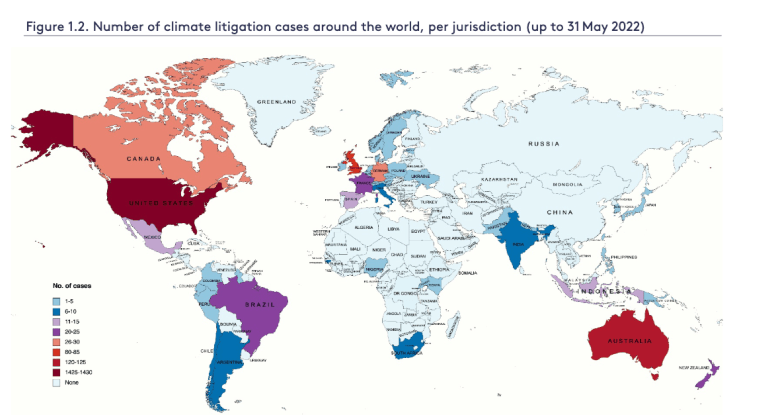
Public Interest Litigation, and specifically climate litigation, has increasingly become a strategy of choice for forcing both government and corporations to reckon with the impacts of climate change. Since 2015, over 2,000 climate related cases have been filed around the world, with over a quarter of them being filed since 2020. Two thirds of these cases have been filed in the United States.
The majority of these cases have been filed against government and administrative agencies, but an increasing number in the last two years have been filed against corporations and the fossil fuel industry.
The London School of Economics “Global Trends in Climate Litigation: 2022 Snapshot” indicates, “Cases are also being filed against a more diverse range of corporate actors. In the calendar year 2021, while 16 of the 38 cases against corporate defendants were filed against fossil fuel companies, more than half were filed against defendants in other sectors, with food and agriculture, transport, plastics and finance all being targeted in multiple cases.” An increasing number are strategic in nature, going beyond individual grievance and aligning with greater climate movement goals of awareness, policy change, and accountability. This is known as strategic climate litigation.
Most of these cases are filed by NGOs and individuals against national governments, subnational governments, and corporate actors, though there are a small number of cases filed against individuals by corporations for interfering with business operations with climate protests (for example ADP Group (Paris Airports) v. Climate Activists).
As litigation becomes a more central strategy for climate movements, the report offers some lessons future litigants should keep in mind.
- Litigation should not happen in a vacuum. More and more, academics and legal experts have noted that litigation is but one tool to impact climate, and can benefit from the use of systems theory and the needs of the impacted community, along with implementing a strategy that is itself climate conscious.
- Litigation does not have to be against the largest emitter to be effective. When viewed as part of a larger strategy of climate intervention, litigation should instead be deployed where it would have the greatest impact. In this way, the litigation can have the greatest impact on the systems that drive climate change, rather than a single instance of malfeasance that may not lead to much difference outside of the initial injury in dispute. The report refers to this as systemic lawyering.
- Litigation must be done with the impacted community at the fore. This is called movement lawyering, which seeks to build upon the power of disadvantaged communities through legal and political strategies. Lawyers can achieve this by co-creating a litigation strategy with the impacted community.
The report demonstrates that litigation is but one strategy used to influence climate policy at all levels of government, and in corporate culture. More and more as lawyers attack the systems that enable and condone climate change, the framework of those systems are forced to reckon with their impacts on non-elite communities and the environment. While currently the success of these cases vary, future litigators must consider how the science and legal norms can be combined by the court to inform their own processes.
 Alisha Eastep, Esquire